

Prices and savings
Grid, generator and battery costs, and how your savings are worked out.
Forecast and weather
Solar forecasts from Solcast or Open-Meteo, and the weather.
Appearance
Branding, background, and which dashboard opens on each device.
Settings → Prices and savings is where you enter what your energy costs, how much wear you count on the battery, and how you'd like your solar savings worked out. All prices are per kWh, in your own currency.
Prices
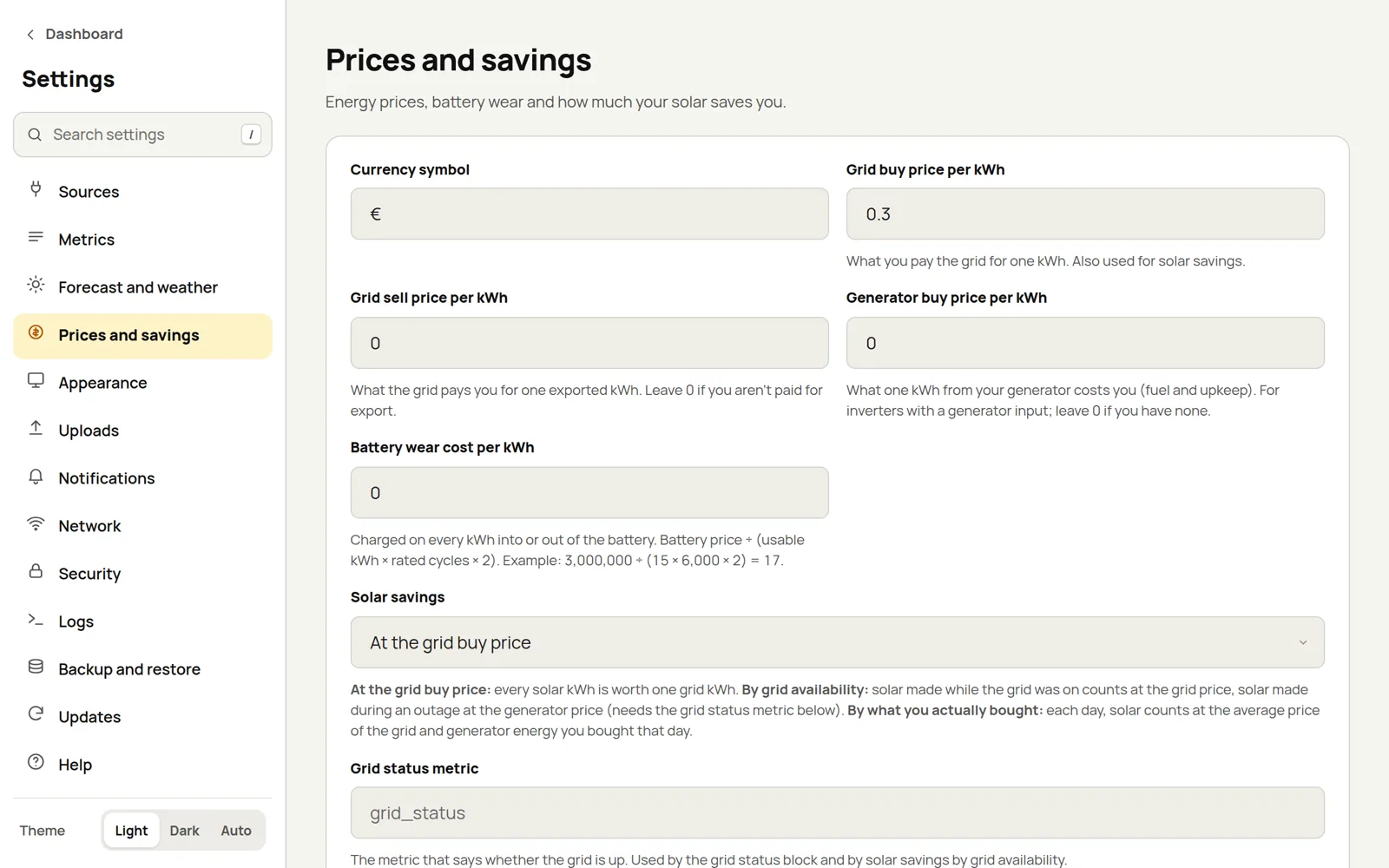
| Field | What it is |
|---|---|
| Currency symbol | For example €, $, £ or ₦. |
| Grid buy price per kWh | What you pay the grid for one kWh. It's also used to value your solar. |
| Grid sell price per kWh | What the grid pays you for each kWh you export. Leave it at 0 if you aren't paid for export. |
| Generator buy price per kWh | What one kWh from your generator costs you, in fuel and upkeep. Only for inverters with a generator input; leave it at 0 if you don't have one. |
| Battery wear cost per kWh | A cost charged on every kWh that goes into or out of the battery. |
The Costs and earnings card uses all of these: what you spent on the grid and the generator (the generator part comes from the daily generator role), what you earned from export, and the battery wear.
Working out battery wear
Divide what the battery cost by (usable kWh × rated cycles × 2). For example, a battery that cost 3,000,000, with 15 kWh usable and rated for 6,000 cycles, works out at 3,000,000 ÷ (15 × 6,000 × 2) = 17 per kWh.
Solar savings
Each day's saving is that day's solar kWh multiplied by a price. Today, this week (from Monday), this month and all time simply add the days up. Solar savings decides which price is used:
| Choice | Price for each solar kWh | Example (4 kWh solar, grid 0.30, generator 0.50) |
|---|---|---|
| At the grid buy price (the default) | The grid price | 4 × 0.30 = 1.20 |
| By grid availability | The grid price for solar made while the grid was on, and the generator price for solar made during an outage. This needs the grid status metric; without it, the grid price is used. | If half was made during an outage: 4 × (0.5 × 0.30 + 0.5 × 0.50) = 1.60 |
| By what you actually bought | The average price of the grid and generator energy you bought that day. On a day when you bought neither, the grid price. | If you bought 2 kWh from the grid and 3 kWh from the generator, the price is 0.42, so 4 × 0.42 = 1.68 |
Set a generator price before choosing either of the generator-based options. With a price of 0, solar made during outages (or the generator part of the average) is counted as worth nothing.
Solar that goes into the battery is valued when it's made, not when you use it later.
Solar energy metric is the metric that counts the solar energy produced today. Leave it empty and Epilykos finds it for you.
Grid status
Grid status metric is the metric that tells Epilykos whether the grid is up; it should read 1 or
on while it is. It drives the Grid status card, the grid outage and grid restored alerts, and
savings worked out by grid availability.
Battery
| Field | What it's for |
|---|---|
| Usable capacity (kWh) | Used to project the battery's charge for the rest of the day. |
| Lowest charge (%) | The charge at which your inverter stops discharging the battery. |
Last updated on